
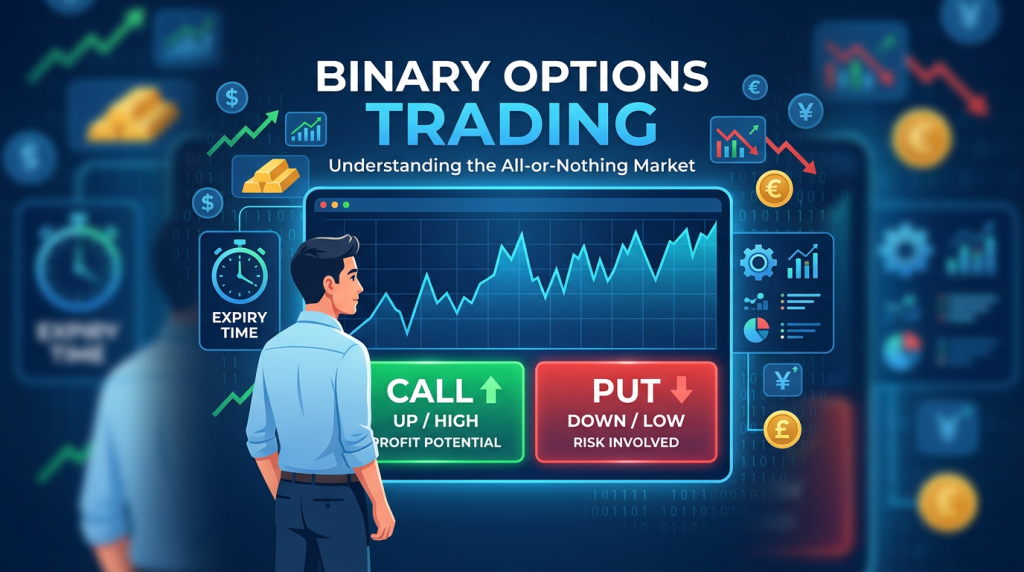
Forex based binary options are fixed payout contracts where the underlying reference is a currency pair such as EURUSD, GBPJPY or USDJPY. You choose a direction and a stake, the contract has a pre-set expiry, and the outcome is a simple yes or no. If the reference price meets the condition at expiry, the option finishes in the money and you receive a fixed payout. If it does not, the option expires worthless and you lose the stake.
In most retail platforms these contracts are short dated. Expiries range from seconds up to a few hours, with a smaller set of daily or weekly expiries. The underlying forex market continues to trade in its usual way, driven by flows, news and macro themes. The binary option just takes a small slice of that path and compresses it into an on–off bet.
For traders with basic forex knowledge the attraction is obvious. Position size is the amount you stake. Maximum loss is clear. There is no margin call. Profit or loss does not depend on how far the price moves beyond the strike, only on whether it gets there at the right moment. At the same time, that simplicity hides trade offs in pricing, flexibility and risk control that are worth unpacking before you treat binaries as a regular way to trade FX.
The particular focus on how to trade forex-based binary options. If you want to learn more about binary options in general and how to make money trading binary options, I recommend you visit BinaryOptions.net. BinaryOptions.net is one of the world’s leading website focused entirely on binary options.
How forex binaries are structured and priced
Underlying FX pairs and expiry choices
The underlying for a forex binary option is usually the spot price of a currency pair taken from a composite feed. The broker or venue defines a set of contracts such as “EURUSD above current price in 15 minutes” or “USDJPY below 145.00 at today’s close”. You pick one side, stake an amount, and the platform tracks whether the condition is met at expiry.
Common contract styles are high or low binaries, where the strike is near the current price, and one-touch or no-touch binaries, where the condition is touching a barrier level before expiry. Some platforms also offer range binaries, where the option pays out if price stays inside a band.
The expiry choice shapes risk. Very short expiries turn the contract into a bet on noise and micro-moves, often dominated by random ticks and spread behaviour. Longer expiries allow more of the underlying directional view or event risk to express, but still cap gains at a fixed payout.
At expiry, the platform reads a settlement price from its FX feed. The rule for which tick counts can vary. It might be the mid quote at a set time, an average over a few seconds, or a last traded price. In regulated setups, that rule is published and audited. In many OTC environments, the broker has more freedom in how that price is defined in practice.
Payout ratios, breakeven win rates and house edge
In forex binaries, the platform normally quotes a payout percentage for each contract. A common pattern is something like “80 percent return” for a short dated high or low contract on a major pair. If you stake 100 and win, you receive 180 in total. If you lose, you receive zero.
This payoff structure is asymmetric. Your loss on a losing trade is the full stake, your gain on a winner is less than the stake. To break even over many trades, you need to win more often than the pure 50–50 coin flip rate. The exact breakeven win rate depends on the payout.
With an 80 percent payout, the breakeven win rate is found by setting expected profit to zero. If p is your win probability, then p times 0.8 stake minus (1 minus p) times 1 stake should equal zero. That leads to p equal to about 55.6 percent. A lower payout pushes the required win rate higher.
The gap between the fair payout for a given set of odds and the actual quoted payout is the house edge. In a fair high or low contract with no costs and symmetric conditions, a fifty percent payout on winners would make client expectancy zero before any slippage. In practice, platforms quote lower payouts. The difference pays for costs and profit margin.
When expiries are very short and strikes are near the current price, many contracts behave like coin flips plus spread. Hitting win rates above the breakeven threshold consistently under those conditions is hard, even before human error. That is why many traders see streaks of wins followed by steep losses once the odds catch up.
Where forex binaries are traded and who offers them
Regulated venues and onshore brokers
In some regions, binary payoff structures tied to forex have been offered through regulated venues or under licences that treat them as investment products. In those cases, binaries trade in a proper order book or are cleared through an exchange. Prices reflect the balance between buyers and sellers. Client funds sit in segregated accounts, and best–execution and conduct rules apply.
Access to such venues is often through standard brokers that also offer other derivatives. The broker routes orders but does not take the other side. Settlement prices follow published procedures. Margin, collateral and reporting use the same systems as other listed contracts.
Regulators in several major markets have restricted or banned marketing of short dated binaries to retail traders due to loss patterns and misconduct over the years. Where products survive, they tend to be longer dated and more aimed at institutional or professional users. Retail access, where allowed, carries heavy risk warnings and tighter limits.
Offshore OTC platforms
Alongside this, a large offshore market built around OTC forex binaries. These platforms operate from lighter regulatory bases and target retail clients globally through online marketing, affiliates and social media. Contracts are created and priced internally.
Here, the “broker” is also the house. It sets payout ratios, manages its own risk book and often packages binaries with other high risk products. Client deposits go to accounts controlled by the operator or its processors. Settlement prices are derived from internal feeds.
Some offshore platforms say they quote based on interbank FX feeds and hedge aggregate exposure. Others run more of a casino model, relying on the statistical edge built into payouts plus natural client loss over time. Transparency on exactly how trades are managed is limited.
For a trader, the practical point is that in this setup you face both market risk and full counterparty risk. Your payoff depends on price behaviour and on the platform’s willingness and ability to honour it. That is a very different situation from trading a listed contract via a regulated broker, even if the screen layout looks similar.
Comparing forex binaries with spot forex and CFDs
Payoff shape and risk profile
The core difference between forex binaries and spot or CFD trading is payoff shape. In spot forex or a CFD, your profit or loss changes continuously with price. If EURUSD moves ten pips in your favour, you gain a certain amount per pip based on your position size. If it moves ten pips against you, you lose that amount. You can exit early, partially close, trail stops and scale.
In a binary, the payoff is fixed. Either the condition is met at expiry and you receive the quoted amount, or it is not and your entire stake is gone. The size of the price move beyond the trigger level does not change that. A one pip win and a thirty pip win pay the same, and a one pip miss loses as much as a wide miss.
That makes risk easier to state but removes granularity. You know exactly what you can lose per trade: the stake. You also know the maximum you can gain. That can encourage traders to place bigger stakes than they would in spot, because the worst case is clear and there is no concept of a margin call.
At portfolio level, this structure reshapes drawdowns. A losing streak in binaries is a string of full–stake losses, which can cut through an account fast. In spot or CFDs, careful use of stop levels and smaller positions can flatten the slope of a bad run. You still lose money, but in smaller bites.
Binary payoff shape also limits how far long–term edges can stretch. In spot, a strategy that catches rare large runs can be very profitable even with a low win rate. In binaries you never capture those outsized gains; wins are capped. That changes the kind of edges that make sense.
Margin, position sizing and order control
In spot forex and CFDs, trading is usually margined. You post a fraction of notional as collateral, and your broker sets a position multiplier. You can size positions as a function of equity and stop distance, risk a fixed proportion per trade, and adjust exposure as account size moves. This lets you tune risk in percentage terms.
In many forex binary setups there is no margin in the same sense. You pay the full stake upfront and there is no borrowing. That sounds safer because you can not lose more than you put in. In practice, traders often respond by raising stake size to levels that would be reckless in a margined account, rationalising that there is no chance of an extra call.
Order control is also different. Spot and CFDs give you a range of order types: market, limit, stop, stop limit, partial closes. You can move stops as a trade develops or cut losers early while letting winners run. With binaries, the main control you have is whether to enter at all and how much to stake. Once the contract is open, many platforms do not allow early exit except at poor prices, if at all.
That lack of control can be harsh around news or thin liquidity periods. In spot, a sudden spike might hit your stop but still leave room for partial salvage or re-entry at better levels. In a binary, any spike that pushes the contract out of the money at expiry is a full loss, regardless of how the underlying behaves a few seconds later.
Typical forex binary trading styles
Short expiry “event” trading
The most common use of forex based binaries on retail platforms is very short expiries. Traders pick five-minute or fifteen-minute contracts on major pairs and try to call whether price will be up or down at the end of that small window.
Some focus on technical signals, such as breakouts from recent ranges, mean reversion after spikes, or moves around common support and resistance levels. Others trade around scheduled data or central bank comments, trying to catch the initial reaction.
The appeal is pace. You get clear feedback quickly. A day of trading might include dozens of contracts and a rollercoaster of in–the–money and out–of–the–money flashes on screen. That tempo is addictive for some personalities.
The issue is that short expiries lean strongly on noise and spread micro-structure. Many apparent patterns on short charts do not have stable statistical edges once you account for the payout structure and small delays in execution. Even if a pattern holds on raw price data, converting it into binary outcomes often lowers the edge because you throw away information about the size of moves.
Longer expiry directional and range ideas
A smaller group of traders use forex binaries at longer horizons. A daily binary might be set to pay out if EURUSD closes above a certain level, or if it stays within a band during a data–light session. These contracts align more with macro or swing style trading, where you care about the full session path rather than a handful of minutes.
Here, the binary behaves a bit closer to a simple digital option in classic derivatives. You base the trade on a view of where price is likely to be by a set time, perhaps tied to event risk like central bank decisions or payroll reports. You might even use other instruments alongside binaries, such as spot positions or vanilla options, to shape exposure.
Longer expiries give more time for a thesis to play out, but the binary cap on payout remains. If the move is larger than expected, you still only receive the fixed amount. Meanwhile, your risk per contract is unchanged. That can make it harder to justify systematic use of long binaries compared with directional positions, unless the pricing is genuinely attractive.
In practice, many serious traders who like digital style payoffs prefer to work with standard options on regulated venues, where pricing, greeks and hedging tools are richer, rather than with OTC forex binaries.
Main risks in forex based binary options
Structural and mathematical issues
The most basic problem is expectancy. With a capped payout below the stake amount and no partial wins, your required hit rate to break even sits above fifty percent. For short dated contracts near the money, where underlying price changes are roughly symmetric over small intervals, that is a tough bar.
Small frictions stack up. Execution delay between clicking and the contract opening, minor differences between your chart price and the settlement feed, and the spread behaviour near expiry all tend to tilt close calls against you. Over enough trades, those close calls matter.
There is also no concept of managing trade risk once the binary is live. In spot, you can cut a trade early if the story changes or if price action invalidates your premise. With a binary, you either hold and accept full loss if wrong, or you close at whatever price the platform offers, which is usually far from fair value in stressed moments.
All this means that even if your directional calls on forex were decent in a continuous payoff world, translating them into binary bets often lowers the edge to the point where platform costs dominate. To overcome that, you would need a very clear, tested edge on binary outcomes specifically, not just on market direction.
Counterparty behaviour and execution risk
When forex binaries are traded OTC, the broker or platform has full control over contract terms, pricing, feeds and settlement. You are not dealing with an independent exchange or clearing house. That adds layers of counterparty and conduct risk.
Execution quality depends entirely on the operator’s systems and policies. During busy periods feeds can freeze, tickets can be rejected, and expiry snapshots can use ticks that differ from what your chart shows. In regulated markets these issues are subject to review and potential sanction. Offshore, complaints often lead nowhere.
Withdrawal risk is another layer. Some operators have been known to delay or refuse payouts to profitable clients, citing bonus abuse or vague rule breaches. Even where firms pay, they may push for re–deposits or higher stakes rather than treating the relationship as a straightforward brokerage service.
Even if a particular platform behaves well today, its future is tied to banking partners, payment processors and local law. A change in any of those can disrupt your access to funds. Since most forex binary platforms do not benefit from deposit insurance schemes or strong segregation rules, clients shoulder that risk almost entirely.
More flexible alternatives for trading forex moves
Spot and CFD trading under regulation
For traders who like forex and want to express short to medium term views, regulated spot or CFD trading is the more flexible route. The contracts are still risky and geared, but at least payoff changes continuously with price, and you can manage risk through stops and position sizing.
With a regulated broker you know how client money is held, what leverage caps apply, and which rules the firm must follow around execution and marketing. You can choose stickier, longer timeframe setups if that suits you, or day trading if you have the skill and capital. Either way, you have more knobs to turn than “stake size and direction on a fixed expiry”.
Cost structure is different too. You pay spreads and maybe commission, plus overnight financing. Those are not small items, but they are visible. You can shop around for better all–in rates, and your expectancy maths uses variable outcomes rather than a binary win or lose per trade.
Vanilla options on FX
Vanilla forex options are another alternative. A simple call or put gives you defined risk and asymmetric payoff. You pay a premium, and your maximum loss is that premium. Gains scale with how far the underlying moves and how volatility behaves, not just with a single yes or no at expiry.
These options trade on OTC markets and, in some cases, on listed venues. Access for smaller traders can be harder than for spot or CFDs, but some brokers offer mini contracts and basic option chains on major pairs.
Working with standard options introduces new concepts such as delta, gamma, theta and implied volatility. That is extra learning, but it also opens more structured approaches, like hedging spot positions, trading event risk with defined loss, or building spreads that cap both upside and downside.
Compared with forex binaries, vanilla options give you more control over the shape of risk and reward. You can still misuse them and lose money, but you are not starting from a house edge baked into every contract in quite the same way.
How to think about forex binaries inside a broader trading plan
Forex based binary options sit at the intersection of two impulses. One is a genuine interest in forex markets and macro themes. The other is an urge for simple, high–impact bets with quick feedback. Platforms lean into the second impulse hard and tend to gloss over how much of the first impulse is actually expressed once every trade becomes a short dated on–off wager.
If your main goal is to become better at reading currency behaviour, sizing positions and managing risk, spot and standard derivatives give you more meaningful practice. You see how trades develop, you can adjust, and you can design methods that stand a chance across many trades and regimes.
If, despite that, you still want some exposure to binary style payoffs on forex, treating them as a small, ring fenced experiment rather than as a core method is usually the cleaner approach. That means small stakes, no borrowing to fund accounts, no assumption that binaries will fix wider financial problems, and a clear set of rules for when to walk away.
Forex binaries compress a rich, continuous market into a series of very sharp yes or no bets. That compression is tidy for marketing but rough for risk. The more time you spend trading, the more you realise that having a few ways to bend or soften an outcome is worth more than the neatness of a fixed payout number on a box in a trading app.
This article was last updated on: March 5, 2026